
Tag Archives: Steinhatchee River

Isaias Strengthens to a Hurricane

Former Tropical Storm Isaias strengthened to a hurricane as it moved over the central Gulf of Mexico on Wednesday night.  At 8:00 a.m. EDT on Thursday the center of Hurricane Isaias was located at latitude 23.7°N and longitude 90.6°W which put the center about 385 miles (620 km) south-southwest of the Mouth of the Mississippi River.  Isaias was moving toward the east-northeast at 9 m.p.h. (15 km/h).  The maximum sustained wind speed was 80 m.p.h. (130 km/h) and there were wind gusts to 95 m.p.h. (150 km/h).  The minimum surface pressure was 975 mb.

A Hurricane Warning is in effect for the portion of the coast from Ocean Springs, Mississippi to the Bay County/ Gulf County line in Florida.  The Hurricane Warning includes Mobile, Alabama and Pensacola, Florida.

A Tropical Storm Warning is in effect for the portion of the coast from the Jefferson Parish/Plaquemines Parish line in Louisiana to Ocean Springs, Mississippi.

A Tropical Storm Warning is in effect for the portion of the coast from the Bay County/Gulf County Line to Aucilla River, Florida.

Former Tropical Storm Isaias strengthened to a hurricane on Wednesday night.
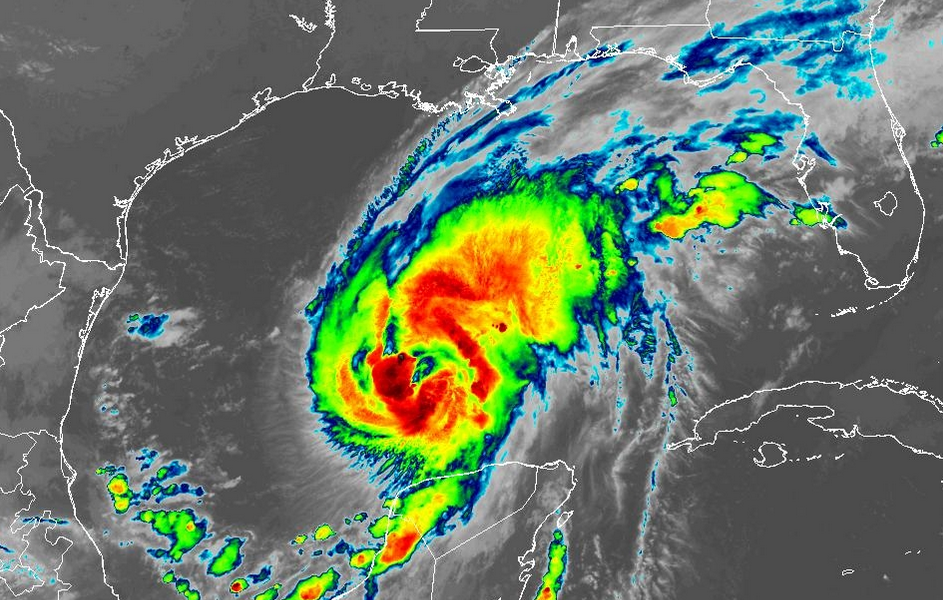
The inner end of a rainband wrapped around the western and southern sides of the center of Hurricane Isaias.  An eye appeared to be forming at the center of Isaias’ circulation.  Bands of showers and thunderstorms were revolving around the center of Isaias’ circulation.  Storms near the center of Isaias generated upper level divergence that pumped mass away from the tropical storm.  The removal of mass caused the surface pressure to decrease.

The strongest winds were occurring in the rainband that wrapped around the western side of the center of Hurricane Isaias.  Winds to hurricane force extended out 20 miles (30 km) in the western side of Isaias’ circulation.  Winds to tropical storm force extended out 90 miles (145 km) from the center of Hurricane Isaias.

Hurricane Isaias will move through an environment that will be favorable for intensification during the next 24 hours.  Isaias will move over water where the Sea Surface Temperatures are near 30°C.  It will move under the southeastern part of an upper level trough that is over the South Central U.S.  The upper level trough will produce westerly winds that will blow toward the top of Isaias’ circulation.  Those winds will cause some vertical wind shear, but the wind shear will not be enough to prevent intensification.  Hurricane Isaias will intensify during the next 24 hours.

Hurricane Isaias will move around the southeastern part of the upper level trough that is over the South Central U.S.   The upper level trough will steer Isaias toward the northeast during the next 24 hours.  On its anticipated track, Isaias will reach the northern Gulf Coast on Friday night.

Hurricane Isaias will bring strong winds and locally heavy rain to the northern Gulf Coast.  Heavy rain could cause flash floods in some locations.

Flood Watches are in effect for parts of southern Mississippi, southern Alabama, and Northwest Florida.

Isaias could cause a storm surge of up to 12 feet (3.6 meters) along portions of the northern Gulf Coast.

A Storm Surge Warning is in effect for the portion of the coast from the Mouth of the Mississippi River to Steinhatchee River, Florida.


Hurricane Warning issued for Northern Gulf Coast

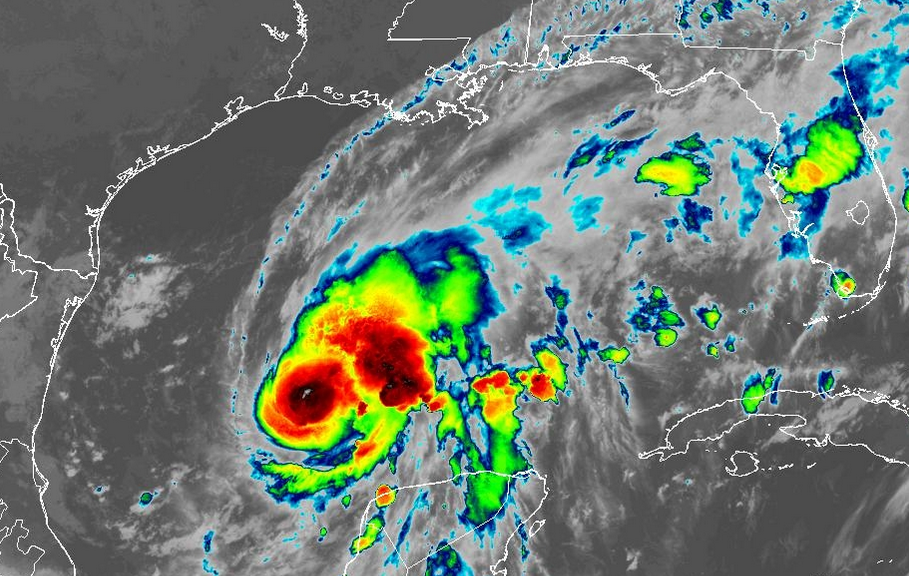
A Hurricane Warning was issued for a portion of the northern Gulf Coast on Wednesday night because of the threat posed by Tropical Storm Isaias.  At 11:00 p.m. EDT on Wednesday the center of Tropical Storm Isaias was located at latitude 22.9°N and longitude 91.9°W which put the center about 460 miles (745 km) south-southwest of the Mouth of the Mississippi River.  Isaias was moving toward the east-northeast at 9 m.p.h. (15 km/h).  The maximum sustained wind speed was 70 m.p.h. (110 km/h) and there were wind gusts to 85 m.p.h. (135 km/h).  The minimum surface pressure was 988 mb.

A Hurricane Warning is in effect for the portion of the coast from Ocean Springs, Mississippi to the Bay County/ Gulf County line in Florida.

A Tropical Storm Warning is in effect for the portion of the coast from the Jefferson Parish/Plaquemines Parish line in Louisiana to Ocean Springs, Mississippi.

A Tropical Storm Warning is in effect for the portion of the coast from the Bay County/Gulf County Line to Aucilla River, Florida.

Tropical Storm Isaias continued to intensify on Wednesday evening.  Isaias was on the threshold of becoming a hurricane.

Bands of showers and thunderstorms were revolving around the center of Isaias’ circulation.  Storms near the center of Isaias generated upper level divergence that pumped mass away from the tropical storm.  The removal of mass caused the surface pressure to decrease.

The distribution of wind speeds in Tropical Storm Isaias was fairly symmetrical.  Winds to tropical storm force extended out 60 miles (95 km) from the center of Isaias’ circulation.

Tropical Storm Isaias will move through an environment that will be favorable for intensification during the next 24 hours.  Isaias will move over water where the Sea Surface Temperatures are near 30°C.  It will move under the middle of an upper level ridge that is over the Gulf of Mexico.  The upper level winds are weak near the middle of the ridge and there will be little vertical wind shear.  Tropical Storm Isaias will intensify during the next 24 hours.  Isaias could intensify rapidly at times.  Tropical Storm Isaias will strengthen to a hurricane by Thursday morning.

Tropical Storm Isaias will move around the southeastern part of an upper level trough that is over the Southern Plains.  The upper level trough will steer Isaias toward the northeast during the next 24 hours.  On its anticipated track, Isaias will reach the northern Gulf Coast on Friday night.

Tropical Storm Isaias will be a hurricane when it reaches the northern Gulf Coast.  Isaias could be a major hurricane when it reaches the coast.  Isaias will bring strong winds and locally heavy rain to the northern Gulf Coast.  Heavy rain could cause flash floods in some locations.

Isaias could cause a storm surge of up to 12 feet (3.6 meters) along portions of the northern Gulf Coast.

A Storm Surge Warning is in effect for the portion of the coast from the Mouth of the Mississippi River to Steinhatchee River, Florida.

Tropical Storm Mindy Forms near Florida Panhandle

Tropical Storm Mindy formed near the Florida Panhandle on Wednesday afternoon. At 5:00 p.m. EDT on Wednesday the center of Tropical Storm Mindy was located at latitude 29.0°N and longitude 86.3°W which put it about 90 miles (145 km) west-southwest of Apalachicola, Florida. Mindy was moving toward the northeast at 21 m.p.h. (33 km/h). The maximum sustained wind speed was 40 m.p.h. (65 km/h) and there were wind gusts to 50 m.p.h. (80 km/h). The minimum surface pressure was 1008 mb.

A Tropical Storm Warning was issued for the portion of the coast from Mexico Beach to the Steinhatchee River, Florida.

A surface low pressure system spun up quickly near the Florida Panhandle on Wednesday afternoon and the National Hurricane Center designated the system as Tropical Storm Mindy. More thunderstorms were forming near the center of Mindy. Storms near the center started to generate upper level divergence that pumped mass away to the northeast of the tropical storm. The removal of mass caused the surface pressure to decrease. NOAA buoy 42039 reported a sustained wind speed of 38 m.p.h. (61 km/h) and a wind gust of 51 m.p.h. (83 km/h) at 4:40 p.m. EDT. The buoy also reported a surface pressure of 1007.8 mb.

Tropical Storm Mindy could strengthen a little during the next few hours before it makes landfall on the coast of Northwest Florida. Mindy will move over water where the Sea Surface Temperature is near 30˚C. It will move under the eastern side of an upper level low over the western Gulf of Mexico. The upper low will produce southwesterly winds that will blow toward the top of Mindy’s circulation. Those winds will cause moderate vertical wind shear and the shear will limit potential intensification.

The upper level low will steer Tropical Storm Mindy quickly toward the northeast during the next 12 hours. On its anticipated track Tropical Storm Mindy will make landfall on the coast near Port St. Joe, Florida on Wednesday evening. Mindy will move more toward the east-northeast on Thursday when it reaches the westerly winds in the middle latitudes. Tropical Storm Mindy will produce gusty winds along the coast of Northwest Florida. Mindy could drop locally heavy rain over parts of northern Florida and southern Georgia. Flash Flood Watches are in effect for parts of northern Florida. Southerly winds on the eastern side of Tropical Storm Mindy will push waves toward the coast and some beach erosion is likely.

Elsewhere, Hurricane Larry moved closer to Bermuda on Wednesday afternoon. At 5:00 p.m. EDT on Wednesday the center of Hurricane Larry was located at latitude 28.9°N and longitude 59.2°W which put it about 405 miles (655 km) southeast of Bermuda. Larry was moving toward the northwest at 15 m.p.h. (24 km/h). The maximum sustained wind speed was 110 m.p.h. (175 km/h) and there were wind gusts to 130 m.p.h. (210 km/h). The minimum surface pressure was 966 mb. A Tropical Storm Warning was in effect for Bermuda.