Category Archives: Eastern and Central Pacific

TCs between Mexico and Hawaii

Tropical Storm Hilary Forms South of Mexico

Tropical Storm Hilary formed over the Eastern North Pacific Ocean south of Mexico on Wednesday morning. At 11:00 a.m. EDT on Wednesday the center of Tropical Storm Hilary was located at latitude 12.4°N and longitude 102.6°W which put it about 470 miles (755 km) south-southeast of Manzanillo, Mexico. Hilary was moving toward the west-northwest at 14 m.p.h. (22 km/h). The maximum sustained wind speed was 40 m.p.h. (65 km/h) and there were wind gusts to 50 m.p.h. (80 km/h). The minimum surface pressure was 1002 mb.

A low pressure system over the Eastern North Pacific Ocean south of Mexico strengthened on Wednesday morning and the U.S. National Hurricane Center designated the system as Tropical Storm Hilary. The circulation around Tropical Storm Hilary was organizing quickly. Multiple bands of showers and thunderstorms were revolving around the center of Hilary’s circulation. Storms near the center generated upper level divergence that pumped mass away from the tropical storm. Winds to tropical storm force extended out 200 miles (325 km) in the northeastern quadrant of Tropical Storm Hilary. Winds in the other parts of Hilary’s circulation were blowing at less than tropical storm force.

Tropical Storm Hilary will move through an environment very favorable for intensification during the next 24 hours. Hilary will move over water where the Sea Surface Temperatures are near 30°C. It will move through a region where the upper level winds are weak and there will be little vertical wind shear. Tropical Storm Hilary will intensify during the next 24 hours. Hilary could intensify rapidly at times. Tropical Storm Hilary is likely to strengthen to a hurricane on Thursday.

Tropical Storm Hilary will move around the western part of a high pressure system over Mexico. The high pressure system will steer Hilary toward the west-northwest during the next 24 hours. On its anticipated track Tropical Storm Hilary will move parallel to the west coast of Mexico. Hilary will move more toward the north when it reaches the western end of the high pressure system during the weekend. Hilary could be near Baja California by Sunday.

Elsewhere, Tropical Storm Greg was spinning southeast of Hawaii and former Hurricane Fernanda weakened to a tropical storm. At 11:00 a.m. EDT on Wednesday the center of Tropical Storm Greg was located at latitude 11.8°N and longitude 151.1°W which put it about 605 miles (975 km) south-southeast of Hilo, Hawaii. Greg was moving toward the west at 14 m.p.h. (22 km/h). The maximum sustained wind speed was 50 m.p.h. (80 km/h) and there were wind gusts to 65 m.p.h. (105 km/h). The minimum surface pressure was 1000 mb.

At 11:00 a.m. EDT on Wednesday the center of Tropical Storm Fernanda was located at latitude 17.1°N and longitude 126.8°W which put it about 1165 miles (1875 km) west-southwest of the southern tip of Baja California. Fernanda was moving toward the west at 15 m.p.h. (24 km/h). The maximum sustained wind speed was 65 m.p.h. (105 km/h) and there were wind gusts to 80 m.p.h. (130 km/h). The minimum surface pressure was 994 mb.

Tropical Storm Greg Moves Southeast of Hawaii

Tropical Storm Greg moved southeast of Hawaii on Tuesday morning. At 11:00 a.m. EDT on Tuesday the center of Tropical Storm Greg was located at latitude 11.1°N and longitude 145.9°W which put it about 850 miles (1370 km) southeast of Hilo, Hawaii. Greg was moving toward the west at 14 m.p.h. (22 km/h). The maximum sustained wind speed was 50 m.p.h. (80 km/h) and there were wind gusts to 65 m.p.h. (105 km/h). The minimum surface pressure was 1000 mb.

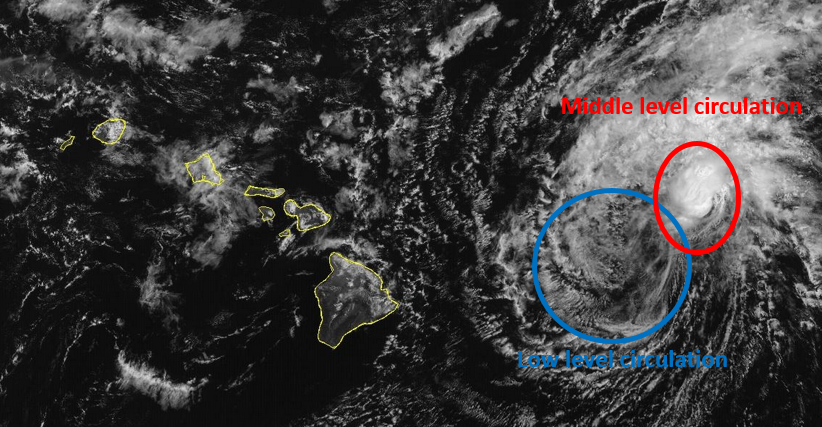
Tropical Storm Greg strengthened a little on Tuesday morning as it moved over the Central Pacific Ocean southeast of Hawaii. Even though Tropical Storm Greg was a little stronger, the distribution of thunderstorms in Greg’s circulation was asymmetrical. Most of the thunderstorms were occurring in bands in the western half of Tropical Storm Greg. Bands in the eastern half of the circulation consisted primarily of showers and lower clouds. Winds to tropical storm force extended out 70 miles (110 km) in the northern half of Greg’s circulation. The winds in the southern half of the circulation were blowing at less than tropical storm force.

Tropical Storm Greg will move through an environment somewhat favorable for intensification during the next 24 hours. Greg will move over water where the Sea Surface Temperatures are near 28°C. It will move under the southwestern part of an upper level ridge over the Eastern North Pacific Ocean. The ridge will produce easterly winds that will blow toward the top of Greg’s circulation. Those winds will cause moderate vertical wind shear. The wind shear is already contributing to an asymmetrical distribution of thunderstorms. The vertical wind shear may not be strong enough to prevent intensification. So, Tropical Storm Greg could intensify a little more during the next 24 hours.

Tropical Storm Greg will move south of a high pressure system over the eastern and central North Pacific Ocean. The high pressure system will steer Greg toward the west during the next 24 hours. On its anticipated track, Tropical Storm Greg will pass far to the south of Hawaii.

Elsewhere, Hurricane Fernanda weakened gradually over the Eastern North Pacific Ocean. At 11:00 a.m. EDT on Tuesday the center of Hurricane Fernanda was located at latitude 17.0°N and longitude 121.8°W which put it about 875 miles (1405 km) west-southwest of the southern tip of Baja California. Fernanda was moving toward the west-northwest at 12 m.p.h. (19 km/h). The maximum sustained wind speed was 110 m.p.h. (175 km/h) and there were wind gusts to 130 m.p.h. (210 km/h). The minimum surface pressure was 967 mb.

Fernanda Rapidly Intensifies to a Major Hurricane

Hurricane Fernanda rapidly intensified to a major hurricane over the Eastern North Pacific Ocean during Sunday night. At 5:00 a.m. EDT on Monday the center of Hurricane Fernanda was located at latitude 15.6°N and longitude 117.7°W which put it about 715 miles (1150 km) southwest of the southern tip of Baja California. Fernanda was moving toward the west at 8 m.p.h. (13 km/h). The maximum sustained wind speed was 125 m.p.h. (200 km/h) and there were wind gusts to 150 m.p.h. (240 km/h). The minimum surface pressure was 959 mb.

Hurricane Fernanda continued to intensify rapidly during Sunday night. A small eye was at the center of Fernanda’s circulation. The eye was surrounded by a ring of thunderstorms and the strongest winds were occurring in that ring of storms. Bands of showers and thunderstorms revolved around the core of Hurricane Fernanda. Storms near the core generated upper level divergence that pumped mass away from the hurricane.

The circulation around Hurricane Fernanda was small. Winds to hurricane force extended out 25 miles (40 km) from the center of Fernanda’s circulation. Winds to tropical storm force extended out 70 miles (110 km) from the center of circulation. The Hurricane Intensity Index (HII) was 23.6. The Hurricane Size Index (HSI) was 7.8 and the Hurricane Wind Intensity Size Index (HWISI) was 31.4.

Hurricane Fernanda will move through an environment favorable for intensification during the next 12 hours. Fernanda will move over water where the Sea Surface Temperatures are near 29°C. It will move through a region where the upper level winds are weak and there will be little vertical wind shear. Hurricane Fernanda is likely to continue to intensify during the next 12 hours. Fernanda will move over slightly cooler water on Tuesday. The cooler water will cause Fernanda to start to weaken.

Hurricane Fernanda will move south of a subtropical high pressure system over the Eastern North Pacific Ocean. The high pressure system will steer Fernanda toward the west during the next 24 hours. On its anticipated track, Hurricane Fernanda will move farther away from Baja California.

Elsewhere, Tropical Storm Greg formed east-southeast of Hawaii. At 5:00 a.m. EDT on Monday the center of Tropical Storm Greg was located at latitude 11.3°N and longitude 139.8°W which put it about 1170 miles (1885 km) east-southeast of Hilo, Hawaii. Greg was moving toward the west at 13 m.p.h. (21 km/h). The maximum sustained wind speed was 40 m.p.h. (65 km/h) and there were wind gusts to 50 m.p.h. (80 km/h). The minimum surface pressure was 1005 mb. Tropical Storm Greg is forecast to pass south of Hawaii later this week.

Fernanda Intensifies to a Hurricane

Former Tropical Storm Fernanda intensified to a hurricane over the Eastern North Pacific Ocean southwest of Baja California on Sunday. At 5:00 p.m. EDT on Sunday the center of Hurricane Fernanda was located at latitude 15.5°N and longitude 116.5°W which put it about 670 miles (1075 km) southwest of the southern tip of Baja California. Fernanda was moving toward the west-northwest at 9 m.p.h. (15 km/h). The maximum sustained wind speed was 75 m.p.h. (120 km/h) and there were wind gusts to 90 m.p.h. (145 km/h). The minimum surface pressure was 995 mb.

Former Tropical Storm Fernanda intensified rapidly to a hurricane on Sunday. The inner end of a rainband wrapped around the center of Hurricane Fernanda’s circulation. A small eye was visible intermittently on satellite images. The eye was surrounded by a ring of thunderstorms and the strongest winds were occurring in that ring of storms. Bands of showers and thunderstorms revolved around the core of Hurricane Fernanda. Storms near the core generated upper level divergence that pumped mass away from the hurricane.

The circulation around Hurricane Fernanda was small. Winds to hurricane force extended out 15 miles (25 km) from the center of Fernanda’s circulation. Winds to tropical storm force extended out 60 miles (95 km) from the center of circulation.

Hurricane Fernanda will move through an environment favorable for intensification during the next 24 hours. Fernanda will move over water where the Sea Surface Temperatures are near 29°C. It will move through a region where the upper level winds are weak and there will be little vertical wind shear. Hurricane Fernanda will intensify during the next 24 hours. Fernanda could intensify rapidly at times. Fernanda could strengthen to a major hurricane on Monday.

Hurricane Fernanda will move south of a subtropical high pressure system over the Eastern North Pacific Ocean. The high pressure system will steer Fernanda toward the west-northwest during the next 24 hours. On its anticipated track, Hurricane Fernanda will move farther away from Baja California.

Tropical Storm Fernanda Forms South of Baja California

Tropical Storm Fernanda formed over the Eastern North Pacific Ocean south of Baja California on Saturday night. At 11:00 p.m. EDT on Saturday the center of Tropical Storm Fernanda was located at latitude 15.0°N and longitude 114.0°W which put it about 610 miles (980 km) south-southwest of the southern tip of Baja California. Fernanda was moving toward the west-northwest at 10 m.p.h. (16 km/h). The maximum sustained wind speed was 45 m.p.h. (75 km/h) and there were wind gusts to 60 m.p.h. (95 km/h). The minimum surface pressure was 1004 mb.

A low pressure system over the Eastern North Pacific Ocean south of Baja California strengthened on Saturday night and the U.S. National Hurricane Center designated the system as Tropical Storm Fernanda. The circulation around Tropical Storm Fernanda was organizing steadily. The inner end of a rainband wrapped around the western and southern side of the center of Fernanda’s circulation. More thunderstorms also formed near the center of circulation. Storms near the center generated upper level divergence that pumped mass away from the tropical storm. Winds to tropical storm force extended out 60 miles (95 km) from the center of Fernanda’s circulation.

Tropical Storm Fernanda will move through an environment favorable for intensification during the next 24 hours. Fernanda will move over water where the Sea Surface Temperatures are near 29°C. It will move through a region where the upper level winds are weak and there will be little vertical wind shear. Tropical Storm Fernanda will intensify during the next 24 hours. Fernanda could strengthen to a hurricane on Sunday.

Tropical Storm Fernanda will move south of a subtropical high pressure system over the Eastern North Pacific Ocean. The high pressure system will steer Fernanda toward the west-northwest during the next 24 hours. On its anticipated track, Tropical Storm Fernanda will move farther away from Baja California.

Hurricane Dora Moves Across the International Date Line

Hurricane Dora moved across the International Date Line on Friday night. At 11:00 p.m. EDT on Friday the center of Hurricane Dora was located at latitude 15.9°N and longitude 179.4°E which put it about 860 miles (1390 km) south of Midway Island. Dora was moving toward the west-northwest at 18 m.p.h. (30 km/h). The maximum sustained wind speed was 105 m.p.h. (165 km/h) and there were wind gusts to 125 m.p.h. (200 km/h). The minimum surface pressure was 972 mb.

Hurricane Dora was weakening as it moved across the International Date Line on Friday night. Dora was moving under the western part of an upper level ridge over the Central Pacific Ocean. The ridge was producing southerly winds that were blowing toward the top of Dora’s circulation. Those winds were causing the vertical wind shear to increase and the wind shear was causing Hurricane Dora to weaken.

There still was a small eye at the center of Hurricane Dora. The eye was surrounded by a ring of thunderstorms and the strongest winds were occurring in that ring of storms. Bands of showers and thunderstorms were revolving around the core of Dora’s circulation. Storms near the core generated upper level divergence that pumped mass away from the hurricane.

The circulation around Hurricane Dora was small. Winds to hurricane force extended out 25 miles (40 km) from the center of Dora. Winds to tropical storm force extended out 90 miles (145 km) from the center of circulation. The Hurricane Intensity Index (HII) was 17.8. The Hurricane Size Index (HSI) was 7.0 and the Hurricane Wind Intensity Size Index (HWISI) was 24.8.

Hurricane Dora will move through an environment that will be unfavorable for intensification during the next 24 hours. Dora will move over water where the Sea Surface Temperatures are near 28°C. However, the upper level ridge will continue to cause moderate to strong vertical wind shear. The wind shear will cause Hurricane Dora to weaken during the next 24 hours. Dora could weaken quickly even though it is over warm water, because it is such a small hurricane.

Hurricane Dora will move around the western side of a high pressure system over the Central Pacific Ocean. The high pressure system will steer Dora toward the west-northwest during the next 24 hours. On its anticipated track Hurricane Dora could be east of Wake Island in 48 hours.

Hurricane Dora Passes South of Johnston Island

Hurricane Dora passed south of Johnston Island early on Thursday. At 5:00 a.m. EDT on Thursday the center of Hurricane Dora was located at latitude 12.1°N and longitude 169.8°W which put it about 320 miles (510 km) south of Johnston Island. Dora was moving toward the west at 22 m.p.h. (35 km/h). The maximum sustained wind speed was 140 m.p.h. (225 km/h) and there were wind gusts to 165 m.p.h. (265 km/h). The minimum surface pressure was 950 mb.

The structure of Hurricane Dora showed signs of changing early on Thursday. The eye at the center of Dora’s circulation got smaller and the eye was more difficult to see on infrared satellite images. Several new bands of thunderstorms developed in the eastern and northern parts of Hurricane Dora. Dora was still a powerful hurricane. Storms near the center of Dora generated upper level divergence that pumped mass away from the hurricane.

The size of the circulation around Hurricane Dora increased a little as its structure began to change. Winds to hurricane force extended out 30 miles (50 km) from the center of Dora’s circulation. Winds to tropical storm force extended out 115 miles (185 km) from the center of circulation. The Hurricane Intensity Index (HII) was 28.3. The Hurricane Size Index (HSI) was 9.9 and the Hurricane Wind Intensity Size Index (HWISI) was 38.2. Hurricane Dora was similar in size and intensity to Hurricane Charley when Charley hits southwest Florida in 2004.

Hurricane Dora will move through an environment that will be favorable for a major hurricane during the next 24 hours. Dora will move over water where the Sea Surface Temperatures are near 28°C. It will move through a region where the upper level winds are weak and there will be little vertical wind shear. Hurricane Dora could be starting an eyewall replacement cycle. If an eyewall replacement cycle is beginning, then Dora is likely to weaken during the next 24 hours, even though the hurricane will be in a favorable environment. Since the circulation around Hurricane Dora is so small, any changes in the environment will have large effects on the intensity of Dora.

Hurricane Dora will move south of a subtropical high pressure system over the North Pacific Ocean. The high pressure system will steer Dora toward the west-northwest during the next 24 hours. On its anticipated track, Hurricane Dora will be move west of the International Date Line on Friday.

Hurricane Dora Passes South of Hawaii

Hurricane Dora passed south of Hawaii on Tuesday. At 11:00 p.m. EDT on Tuesday the center of Hurricane Dora was located at latitude 11.4°N and longitude 160.1°W which put it about 700 miles (1125 km) south-southwest of Honolulu, Hawaii. Dora was moving toward the west at 23 m.p.h. (37 km/h). The maximum sustained wind speed was 130 m.p.h. (210 km/h) and there were wind gusts to 155 m.p.h. (250 km/h). The minimum surface pressure was 953 mb.

Hurricane Dora changed very little on Tuesday. The structure of Dora continued to be very symmetrical. An eye with a diameter of 12 miles (19 km) was still at the center of Hurricane Dora. The eye was surrounded by a ring of thunderstorms and the strongest winds were occurring in that ring of storms. Bands of showers and thunderstorms were revolving around the core of Dora’s circulation. Storms near the core generated upper level divergence that pumped mass away from the hurricane.

The size of the circulation around Hurricane Dora did not change much on Tuesday either. Winds to hurricane force extended out 30 miles (50 km) from the center of Dora’s circulation. Winds to tropical storm force extended out 115 miles (185 km) from the center of circulation. The Hurricane Intensity Index (HII) was 25.1. The Hurricane Size Index (HSI) was 9.9 and the Hurricane Wind Intensity Size Index (HWISI) was 35.0.

Hurricane Dora will move through an environment that will be favorable for a major hurricane during the next 24 hours. Dora will move over water where the Sea Surface Temperatures are near 27°C. It will move through a region where the upper level winds are weak and there will be little vertical wind shear. Hurricane Dora has been in equilibrium with its environment during the past 24 hours. The intensity of Dora may not change much during the next 24 hours. Since the circulation around Hurricane Dora is so small, any changes in the environment will have large effects on the intensity of Dora.

Hurricane Dora will move south of a subtropical high pressure system over the North Pacific Ocean. The high pressure system will steer Dora toward the west during the next 24 hours. On its anticipated track, Hurricane Dora will be near Johnston Island on Thursday.

Hurricane Dora Moves Southeast of Hawaii

Hurricane Dora moved southeast of Hawaii on Monday. At 11:00 p.m. EDT on Monday the center of Hurricane Dora was located at latitude 12.0°N and longitude 152.3°W which put it about 565 miles (905 km) south-southeast of Hilo, Hawaii. Dora was moving toward the west at 23 m.p.h. (37 km/h). The maximum sustained wind speed was 130 m.p.h. (210 km/h) and there were wind gusts to 155 m.p.h. (250 km/h). The minimum surface pressure was 953 mb.

Hurricane Dora weakened slightly on Monday. The structure of Dora continued to be very symmetrical. An eye with a diameter of 12 miles (19 km) was at the center of Hurricane Dora. The eye was surrounded by a ring of thunderstorms and the strongest winds were occurring in that ring of storms. Bands of showers and thunderstorms were revolving around the core of Dora’s circulation. Storms near the core generated upper level divergence that pumped mass away from the hurricane.

The size of the circulation around Hurricane Dora increased a little on Monday. Winds to hurricane force extended out 30 miles (50 km) from the center of Dora’s circulation. Winds to tropical storm force extended out 115 miles (185 km) from the center of circulation. The Hurricane Intensity Index (HII) was 25.1. The Hurricane Size Index (HSI) was 9.9 and the Hurricane Wind Intensity Size Index (HWISI) was 35.0.

Hurricane Dora will move through an environment that will be favorable for a major hurricane during the next 24 hours. Dora will move over water where the Sea Surface Temperatures are near 26.5°C. It will move through a region where the upper level winds are weak and there will be little vertical wind shear. Hurricane Dora could move into a region where the air is a little drier. Since the circulation around Hurricane Dora is so small, any changes in the environment will have large effects on the intensity of Dora. Hurricane Dora could weaken a little more during the next 24 hours because of the drier air.

Hurricane Dora will move south of a subtropical high pressure system over the North Pacific Ocean. The high pressure system will steer Dora toward the west during the next 24 hours. On its anticipated track, Hurricane Dora will pass south of Hawaii on Tuesday.

Elsewhere, former Tropical Storm Eugene weakened west of Baja California on Monday. At 5:00 p.m. EDT on Monday the center of Tropical Depression Eugene was located at latitude 25.1°N and longitude 120.4°W which put it about 680 miles (1095 km) west-northwest of the southern tip of Baja California. Eugene was moving toward the west-northwest at 14 m.p.h. (22 km/h). The maximum sustained wind speed was 35 m.p.h. (55 km/h) and there were wind gusts to 45 m.p.h. (75 km/h). The minimum surface pressure was 1008 mb.

Hurricane Dora Moves over the Central Pacific

Hurricane Dora moved over the Central Pacific Ocean on Sunday. At 11:00 p.m. EDT on Sunday the center of Hurricane Dora was located at latitude 12.7°N and longitude 144.0°W which put it about 890 miles (1430 km) east-southeast of the South Point, Hawaii. Dora was moving toward the west at 22 m.p.h. (35 km/h). The maximum sustained wind speed was 140 m.p.h. (225 km/h) and there were wind gusts to 165 m.p.h. (270 km/h). The minimum surface pressure was 950 mb.

Hurricane Dora did not change much on Sunday. The structure of Dora continued to be very symmetrical and it had a a shape sometimes called an annular hurricane. An eye with a diameter of 17 miles (28 km) was at the center of Hurricane Dora. The eye was surrounded by a ring of thunderstorms and the strongest winds were occurring in that ring of storms. Short bands of showers and thunderstorms were revolving around the core of Dora’s circulation. Storms near the core generated upper level divergence that pumped mass away from the hurricane.

The circulation around Hurricane Dora was still very small. Winds to hurricane force extended out 25 miles (40 km) from the center of Dora’s circulation. Winds to tropical storm force extended out 70 miles (110 km) from the center of circulation. The Hurricane Intensity Index (HII) was 28.3. The Hurricane Size Index (HSI) was only 7.0 and the Hurricane Wind Intensity Size Index (HWISI) was 35.36. Hurricane Dora was similar in size and intensity to Hurricane Charley when Charley hit southwest Florida in 2004.

Hurricane Dora will move through an environment that will be favorable for a powerful hurricane during the next 24 hours. Dora will move over water where the Sea Surface Temperatures are near 26.5C. It will move through a region where the upper level winds are weak and there will be little vertical wind shear. Hurricane Dora could move into a region where the air is a little drier. The intensity of an annual hurricane usually remains relatively constant. However, since the circulation around Hurricane Dora is so small, any changes in the environment will have large effects on the intensity of Dora. Hurricane Dora could weaken a little during the next 24 hours, if it moves into a region where the air is a little drier.

Hurricane Dora will move south of a subtropical high pressure system over the Eastern North Pacific Ocean. The high pressure system will steer Dora toward the west during the next 24 hours. On its anticipated track, Hurricane Dora will pass south of Hawaii on Tuesday.

Elsewhere over the Eastern North Pacific Ocean, Tropical Storm Eugene moved south of Baja California on Sunday. At 11:00 p.m. EDT on Sunday the center of Tropical Storm Eugene was located at latitude 23.3°N and longitude 115.0°W which put it about 325 miles (525 km) west of the southern tip of Baja California. Eugene was moving toward the west-northwest at 20 m.p.h. (32 km/h). The maximum sustained wind speed was 60 m.p.h. (95 km/h) and there were wind gusts to 75 m.p.h. (120 km/h). The minimum surface pressure was 997 mb. Tropical Storm Eugene will weaken on Monday as it moves over cooler water west of Baja California.