Tag Archives: Cabo San Lazaro

Tropical Storm Raymond Forms South of Mexico

Tropical Storm Raymond formed over the Eastern North Pacific Ocean south of Mexico on Thursday.  At 2:00 p.m. EDT on Thursday the center of Tropical Storm Raymond was located at latitude 16.1°N and longitude 101.0°W which put the center about 115 miles (185 km) south-southeast of Zihuatanejo, Mexico.  Raymond was moving toward the northwest at 9 m.p.h. (15 km/h).  The maximum sustained wind speed was 40 m.p.h. (65 km/h) and there were wind gusts to 50 m.p.h. (80 km/h).  The minimum surface pressure was 1002 mb.

A Tropical Storm Watch is in effect for the portion of the coast from Zihuatanejo to Cabo Corrientes, Mexico.

A low pressure system over the Eastern North Pacific Ocean south of Mexico strengthened on Thursday and the U.S. National Hurricane Center designated the system as Tropical Storm Raymond.

The distribution of thunderstorms in Tropical Storm Raymond was asymmetrical.  Thunderstorms were occurring in bands in the southern and western parts of Raymond’s circulation.  Bands in the northern and eastern parts of Tropical Storm Raymond consisted primarily of shower and lower clouds.  Storms near the center of Raymond started to generate upper level divergence that pumped mass away to the west of the tropical storm.

Tropical Storm Raymond will move through an environment that will be somewhat favorable for intensification during the next 24 hours.  Raymond will move over water where the Sea Surface Temperatures are near 29°C.  It will move under the southern part of an upper level ridge that is over Mexico.  The upper level ridge will produce easterly winds that will blow toward the top of Raymond’s circulation.  Those winds will cause strong vertical wind shear.  The strong wind shear will inhibit intensification.  Tropical Storm Raymond could intensify a little on Friday if the upper level winds do not get any stronger.

Tropical Storm Raymond will move around the western side of a high pressure system that is over Mexico.  The high pressure system will steer Raymond toward the northwest during the next 24 hours.  On its anticipated track, the center of Tropical Storm Raymond will move near the coast of Mexico between Zihuatanejo and Cabo Corrientes on Friday.

Tropical Storm Raymond will bring gusty winds and locally heavy rain to coastal sections of Colima, Michoacan, and western Guerrero.

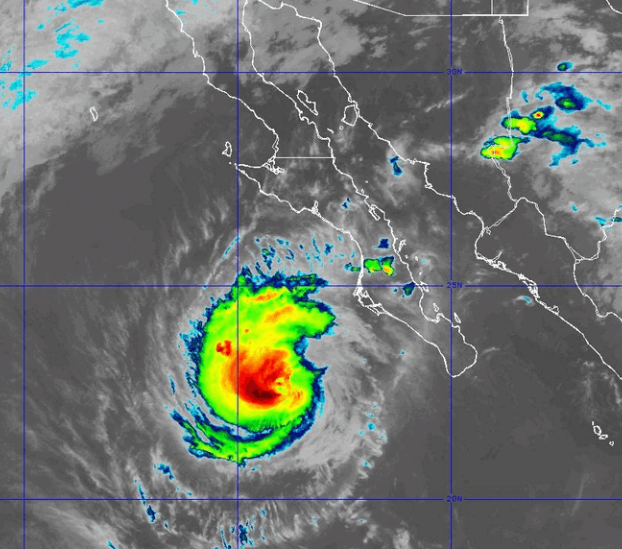
Elsewhere over the Eastern North Pacific Ocean, Tropical Storm Priscilla continued to weaken west of Baja California.  At 11:00 a.m. EDT on Thursday the center of Tropical Storm Priscilla was located at latitude 23.8°N and longitude 114.7°W which put the center about 165 miles (265 km) west-southwest of Cabo San Lazaro, Mexico.  Priscilla was moving toward the north-northwest at 8 m.p.h. (13 km/h).  The maximum sustained wind speed was 45 m.p.h. (75 km/h) and there were wind gusts to 60 m.p.h. (95 km/h).  The minimum surface pressure was 996 mb.

Priscilla Weakens to a Tropical Storm

Former Hurricane Priscilla weakened to a tropical storm over the Eastern North Pacific Ocean south of Baja California on Wednesday afternoon.  At 2:00 p.m. EDT on Wednesday the center of Tropical Storm Priscilla was located at latitude 21.7°N and longitude 112.7°W which put the center about 195 miles (310 km) west-southwest of the southern tip of Baja California.  Priscilla was moving toward the northwest at 7 m.p.h. (11 km/h).  The maximum sustained wind speed was 70 m.p.h. (110 km/h) and there were wind gusts to 85 m.p.h. (135 km/h).  The minimum surface pressure was 985 mb.

A Tropical Storm Watch was in effect for the portion of the coast from Cabo San Lucas to Cabo San Lazaro, Mexico.

Former Hurricane Priscilla rapidly weakened to a tropical storm south of Baja California on Wednesday.  Thunderstorms around the center of Priscilla’s circulation and in the northern half of the circulation weakened.  Bands in those parts of Tropical Storm Priscilla consisted primarily of showers and lower clouds.  Thunderstorms were still occurring in bands in the southern and western periphery of Priscilla’s circulation.  Weakening of the thunderstorms near the core of Tropical Storm Priscilla greatly reduced the upper level divergence.  With much less upper level divergence the inflow of mass in the lower levels of the atmosphere caused the surface pressure to increase.

The circulation around Tropical Storm Priscilla was still large.  Winds to tropical storm force extended out 160 miles (260 km) from the center of Priscilla’s circulation.

Tropical Storm Priscilla will move through an environment that will become even more unfavorable for intensification during the next 24 hours.  Priscilla will move over water where the Sea Surface Temperatures are near 26°C.  An upper level trough near the west coast of the U.S. will produce southwesterly winds that will blow toward the top of Priscilla’s circulation.  Those winds will cause the vertical wind shear to increase.  The effects of cooler water and increasing vertical wind shear will cause Tropical Storm Priscilla to continue to weaken during the next 24 hours.

Tropical Storm Priscilla will move around the western end of a high pressure system over Mexico.  The high pressure system will steer Priscilla toward the north-northwest during the next 24 hours.  On its anticipated track, Tropical Storm Priscilla will move west of Cabo San Lazaro on Thursday.

Elsewhere over the Eastern North Pacific Ocean, Tropical Storm Octave continued to gradually weaken far to the southwest of Baja California.  At 11:00 a.m. EDT on Wednesday the center of Tropical Storm Octave was located at latitude 15.4°N and longitude 116.2.°W which put the center about 660 miles (1065 km) southwest of the southern tip of Baja California.  Octave was moving toward the east at 12 m.p.h. (19 km/h).  The maximum sustained wind speed was 40 m.p.h. (65 km/h) and there were wind gusts to 50 m.p.h. (80 km/h).  The minimum surface pressure was 1003 mb.

Hurricane Priscilla Starts to Weaken

Hurricane Priscilla started to weaken on Tuesday evening.  At 11:00 p.m. EDT on Tuesday the center of Hurricane Priscilla was located at latitude 20.6°N and longitude 111.5°W which put the center about 190 miles (305 km) south-southwest of the southern tip of Baja California.  Priscilla was moving toward the northwest at 9 m.p.h. (15 km/h).  The maximum sustained wind speed was 105 m.p.h. (165 km/h) and there were wind gusts to 125 m.p.h. (200 km/h).  The minimum surface pressure was 962 mb.

A Tropical Storm Watch was in effect for the portion of the coast from Cabo San Lucas to Cabo San Lazaro, Mexico.

Hurricane Priscilla started to weaken on Tuesday evening after Priscilla had strengthened to Category 2 on the Saffir-Simpson Scale earlier in the day.  Hurricane Priscilla appeared to have mixed cooler water to the surface of the Eastern North Pacific Ocean.  A large eye with a diameter of 50 miles (80 km) was still present at the center of Priscilla’s circulation.  However, the ring of thunderstorms surrounding the eye was broken in several places.  Also, many of the thunderstorms in bands in the eastern side of Hurricane Priscilla had weakened.  The bands in the eastern part of Priscilla’s circulation consisted primarily of showers and lower clouds.  Thunderstorms were still occurring in bands in the western half of Hurricane Priscilla.

The circulation around Hurricane Priscilla was still large.  Winds to hurricane force extended out 45 miles (75 km) from the center of Priscilla’s circulation.  Winds to tropical storm force extended out 195 miles (315 km) from the center of Hurricane Priscilla.

The Hurricane Intensity Index (HII) for Hurricane Priscilla was 17.8.  The Hurricane Size Index (HSI) was 17.1 and the Hurricane Wind Intensity Size Index (HWISI) was 34.9.

Hurricane Priscilla will move through an environment that will become more unfavorable for intensification during the next 24 hours.  An upper level trough near the west coast of the U.S. will start to produce southwesterly winds that will blow toward the top of Priscilla’s circulation.  Those winds will cause the vertical wind shear to begin to increase.  In addition, the cooler water mixed to the surface of the ocean by Priscilla’s winds will limit the energy transfer from the ocean to the atmosphere.  The effects of cooler water and increasing vertical wind shear will cause Hurricane Priscilla to weaken during the next 24 hours.

Hurricane Priscilla will move around the western end of a high pressure system over Mexico.  The high pressure system will steer Priscilla toward the north-northwest during the next 24 hours.  On its anticipated track, Hurricane Priscilla will move parallel to the coast of southwestern Baja California on Wednesday.

Elsewhere over the Eastern North Pacific Ocean, Tropical Storm Octave weakened far to the southwest of Baja California.  At 11:00 p.m. EDT on Tuesday the center of Tropical Storm Octave was located at latitude 15.2°N and longitude 118.0.°W which put the center about 750 miles (1205 km) southwest of the southern tip of Baja California.  Octave was moving toward the east at 7 m.p.h. (11 km/h).  The maximum sustained wind speed was 45 m.p.h. (75 km/h) and there were wind gusts to 60 m.p.h. (95 km/h).  The minimum surface pressure was 1000 mb.

Hurricane Priscilla Moves South of Baja California

Hurricane Priscilla moved south of Baja California on Monday night.  At 11:00 p.m. EDT on Monday the center of Hurricane Priscilla was located at latitude 19.1°N and longitude 108.5°W which put the center about 275 miles (445 km) south-southeast of the southern tip of Baja California.  Priscilla was moving toward the northwest at 9 m.p.h. (15 km/h).  The maximum sustained wind speed was 85 m.p.h. (135 km/h) and there were wind gusts to 100 m.p.h. (160 km/h).  The minimum surface pressure was 972 mb.

A Tropical Storm Watch was in effect for the portion of the coast from Cabo San Lucas to Cabo San Lazaro, Mexico.

Hurricane Priscilla was showing evidence of intensification on Monday evening.  New tall thunderstorms were forming just to the south of the center of Priscilla’s circulation.  Microwave satellite imagery was indicating that an eye might be forming at the center of Hurricane Priscilla.  Bands of showers and thunderstorms were revolving around the center.  Storms near the center of Priscilla generated upper level divergence that pumped mass away from the hurricane.  The removal of mass caused the surface pressure to decrease.

The circulation around Hurricane Priscilla was very large.  Winds to hurricane force extended out 50 miles (80 km) in the eastern side of Priscilla’s circulation.  Winds to hurricane force extended out 25 miles (40 km) in the western side of Priscilla.  Winds to tropical storm force extended out 185 miles (295 km) from the center of Hurricane Priscilla.

Hurricane Priscilla will move through an environment favorable for intensification during the next 24 hours.  Priscilla will move over water where the Sea Surface Temperatures are near 28°C.  It will move under the middle of an upper level ridge over Mexico and the Eastern North Pacific Ocean.  The upper level winds are weak near the middle of the ridge and there will be little vertical wind shear.  Hurricane Priscilla will intensify during the next 24 hours.  Priscilla could strengthen to a major hurricane on Tuesday.

Hurricane Priscilla will move around the western end of a high pressure system over Mexico.  The high pressure system will steer Priscilla slowly toward the northwest during the next 24 hours.  On its anticipated track, Hurricane Priscilla will move closer to the southern part of Baja California on Tuesday.

Elsewhere over the Eastern North Pacific Ocean, former Hurricane Octave weakened back to a tropical storm on Monday.  At 11:00 p.m. EDT on Monday the center of Tropical Storm Octave was located at latitude 15.8°N and longitude 120.4°W which put the center about 840 miles (1355 km) southwest of the southern tip of Baja California.  Octave was moving toward the east-southeast at 7 m.p.h. (11 km/h).  The maximum sustained wind speed was 50 m.p.h. (80 km/h) and there were wind gusts to 65 m.p.h. (105 km/h).  The minimum surface pressure was 998 mb.

Lorena Weakens to a Tropical Storm

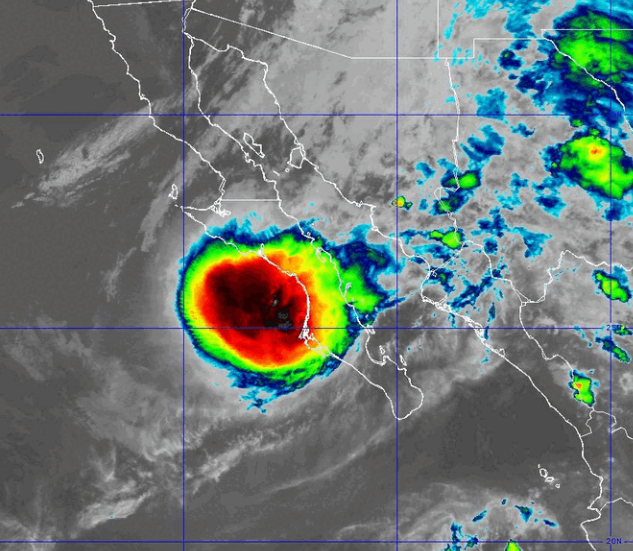
Former Hurricane Lorena weakened to a tropical storm over the Eastern North Pacific Ocean southwest of Baja California on Thursday morning.  At 11:00 a.m. EDT on Thursday the center of Tropical Storm Lorena was located at latitude 24.2°N and longitude 114.2°W which put the center about 125 miles (200 km) west-southwest of Cabo San Lazaro, Mexico.  Lorena was moving toward the northwest at 8 m.p.h. (13 km/h).  The maximum sustained wind speed was 70 m.p.h. (110 km/h) and there were wind gusts to 85 m.p.h. (135 km/h).  The minimum surface pressure was 991 mb.

A Tropical Storm Warning is in effect for the portion of the coast from Puerto Cortes to Punta Eugenia, Mexico.

Former Hurricane Lorena weakened to a tropical storm over the Eastern North Pacific Ocean southwest of Baja California on Thursday morning.  A upper level trough that is west of Baja California was producing southwesterly winds that were blowing toward the top of Lorena’s circulation.  Those winds were causing strong vertical wind shear.  The strong wind shear was pushing the middle and upper parts of Tropical Storm Lorena to the northeast of the surface circulation.  Thunderstorms were still occurring in bands in the northeastern part of Lorena’s circulation.  Bands in the other parts of Lorena consisted primarily of showers and lower clouds.

The circulation around Tropical Storm Lorena was small.  Winds to tropical storm force extended  out 70 miles (110 km) from the center of Lorena’s circulation.

Tropical Storm Lorena will move through an environment that will be unfavorable for intensification during the next 24 hours.  Lorena will move over water where the Sea Surface Temperatures are near 24°C.  The upper level trough that is west of Baja California will continue to cause strong vertical wind shear.  The combination of cool Sea Surface Temperatures and strong vertical wind shear will cause Tropical Storm Lorena to weaken steadily during the next 24 hours.

The strong vertical wind shear is likely to separate the lower portion of Tropical Storm Lorena from the middle and upper parts of Lorena’s circulation.  The lower portion of Lorena’s circulation could meander west of Baja California.  The middle and upper parts of Tropical Storm Lorena will be steered toward the northeast by the upper level trough that is west of Baja California.

The middle and upper parts of Tropical Storm Lorena will move across Baja California, over Sonora, and toward New Mexico and southeastern Arizona.  The middle and upper parts of Lorena’s circulation will bring gusty winds and locally heavy rain to those areas.  The strongest winds will occur in mountainous regions.  Heavy rain could cause flash floods in some locations.

Elsewhere, Hurricane Kiko continued to churn slowly toward Hawaii.  At 11:00 a.m. EDT on Thursday the center of Hurricane Kiko was located at latitude 13.8°N and longitude 133.7°W which put the center about 1470 miles (2365 km) east-southeast of Hilo Hawaii.  Kiko was moving toward the west at 9 m.p.h. (15 km/h).  The maximum sustained wind speed was 130 m.p.h. (210 km/h) and there were wind gusts to 155 m.p.h. (250 km/h).  The minimum surface pressure was 951 mb.

Hurricane Lorena Moves Toward Baja California

Hurricane Lorena was moving toward Baja California on Wednesday evening.  At 11:00 p.m. EDT on Wednesday the center of Hurricane Lorena was located at latitude 23.4°N and longitude 113.2°W which put the center about 110 miles (175 km) south-southwest of Cabo San Lazaro, Mexico.  Lorena was moving toward the northwest at 12 m.p.h. (19 km/h).  The maximum sustained wind speed was 85 m.p.h. (135 km/h) and there were wind gusts to 100 m.p.h. (160 km/h).  The minimum surface pressure was 981 mb.

A Tropical Storm Warning is in effect for the portion of the coast from Santa Fe to Punta Eugenia, Mexico.

A Tropical Storm Watch is in effect for the portion of the coast from Todos Santos to Sante Fe, Mexico.  A Tropical Storm Watch is in effect for the portion of the coast from Santa Rosalia to Bahia de Los Angeles, Mexico.

Hurricane Lorena strengthened a little more on Wednesday.  The inner end of a rainband wrapped around the center of Lorena’s circulation.  However, an eye was not visible on satellite images.  Bands of showers and thunderstorms were revolving around the center of Hurricane Lorena.  Storms near the center of Lorena generated upper level divergence that pumped mass away to the northeast of the hurricane.

The circulation around Hurricane Lorena was small.  Winds to hurricane force extended out 20 miles (30 km) in the northeastern quadrant of Lorena’s circulation.  Winds to tropical storm force extended out 80 miles (130 km) from the center of Hurricane Lorena.

Hurricane Lorena will move through an environment that will become unfavorable for intensification during the next 24 hours.  Lorena will move over water where the Sea Surface Temperatures are near 25°C.  It will move under the southeastern part of an upper level trough that is west of Baja California.  The upper level trough will produce southwesterly winds that will blow toward the top of Lorena’s circulation.  Those winds will cause the vertical wind shear to increase.  The combination of cooler Sea Surface Temperatures and more vertical wind shear will cause Hurricane Lorena to weaken on Thursday.

Hurricane Lorena will move around the western end of a high pressure system that is over Mexico.  The high pressure system will steer Lorena toward the north during the next 24 hours.  The upper level trough that is west of Baja California will steer Lorena toward the northeast later on Thursday.  On its anticipated track, Hurricane Lorena will approach the coast of Baja California between Cabo San Lazaro and Punta Eugenia on Friday.

Hurricane Lorena will weaken to a tropical storm before it reaches the coast of Baja California.  Lorena will bring strong winds and locally heavy rain to parts of Baja California.  Heavy rain could cause flash floods in some locations.

Elsewhere, Hurricane Kiko strengthened to a Category 4 hurricane on the Saffir-Simpson Scale far to the east-southeast of Hawaii.  At 11:00 p.m. EDT on Wednesday the center of Hurricane Kiko was located at latitude 13.8°N and longitude 132.3°W which put the center about 1560 miles (2510 km) east-southeast of Hilo Hawaii.  Kiko was moving toward the west at 9 m.p.h. (15 km/h).  The maximum sustained wind speed was 145 m.p.h. (235 km/h) and there were wind gusts to 170 m.p.h. (275 km/h).  The minimum surface pressure was 944 mb.

Lorena Intensifies to a Hurricane

Former Tropical Storm Lorena intensified to a hurricane over the Eastern North Pacific Ocean south of Baja California on Tuesday night.  The government of Mexico issued a Tropical Storm Warning for a portion of the coast of Baja California.  At 8:00 a.m. EDT on Wednesday the center of Hurricane Lorena was located at latitude 21.9°N and longitude 111.1°W which put the center about 105 miles (165 km) southwest of Cabo San Lucas, Mexico.  Lorena was moving toward the northwest at 15 m.p.h. (24 km/h).  The maximum sustained wind speed was 75 m.p.h. (120 km/h) and there were wind gusts to 90 m.p.h. (145 km/h).  The minimum surface pressure was 990 mb.

A Tropical Storm Warning was in effect for a portion of the coast from Santa Fe to Cabo San Lazaro, Mexico.

A Tropical Storm Watch was in effect for the portion of the coast from Cabo San Lucas to Santa Fe, Mexico.  A Tropical Storm Watch was in effect for the portion of the coast from Cabo San Lazaro to Punta Abreojos, Mexico.

Former Tropical Storm Lorena intensified to a hurricane on Tuesday night.  The inner end of a rainband wrapped part of the way around the center of Lorena’s circulation.  A small eye appeared to be forming at the center of Hurricane Lorena.  Bands of showers and thunderstorms were revolving around the center of Lorena’s circulation.  Storms near the center of Lorena generated upper level divergence that pumped mass away from the hurricane.  The removal of mass caused the surface pressure to decrease.

The circulation around Hurricane Lorena was small.  Winds to hurricane force extended out 15 miles (25 km) in the northeastern quadrant of Lorena’s circulation.  Winds to tropical storm force extended out 60 miles (95 km) from the center of Hurricane Lorena.

Hurricane Lorena will move through an environment favorable for intensification during the next 24 hours.  Lorena will move over water where the Sea Surface Temperatures are near 29°C.  It will move under the western part of the axis of an upper level ridge over Mexico.  The upper level winds are weak near the axis of the ridge and there will be little vertical wind shear.  Hurricane Lorena will intensify during the next 24 hours.  Lorena could intensify rapidly at times on Wednesday.

Hurricane Lorena will move around the western end of a high pressure system over Mexico.  The high pressure system will steer Lorena toward the northwest during the next 24 hours.  Lorena is expected to move toward the north on Thursday.  On it anticipated track, Hurricane Lorena could approach the coast of Baja California between Cabo San Lazaro and Punta Eugenia on Friday.

Elsewhere over the Eastern North Pacific Ocean, Hurricane Kiko continued to churn toward the west.  At 5:00 a.m. EDT on Wednesday the center of Hurricane Kiko was located at latitude 13.8°N and longitude 130.1°W which put the center about 1700 miles (2735 km) east Hilo Hawaii.  Kiko was moving toward the west at 7 m.p.h. (11 km/h).  The maximum sustained wind speed was 105 m.p.h. (165 km/h) and there were wind gusts to 125 m.p.h. (200 km/h).  The minimum surface pressure was 973 mb.


Lorena Prompts Tropical Storm Watch for Baja California

The risk posed by Tropical Storm Lorena prompted the government of Mexico to issue a Tropical Storm Watch for a portion of the coast of southern Baja California.  At 5:00 p.m. EDT on Tuesday the center of Tropical Storm Lorena was located at latitude 19.4°N and longitude 109.0°W which put the center about 250 miles (400 km) south-southeast of Cabo San Lucas, Mexico.  Lorena was moving toward the northwest at 15 m.p.h. (24 km/h).  The maximum sustained wind speed was 50 m.p.h. (80 km/h) and there were wind gusts to 65 m.p.h. (105 km/h).  The minimum surface pressure was 1002 mb.

A Tropical Storm Watch is in effect for the portion of the coast from Cabo San Lucas to Cabo San Lazaro, Mexico.

Tropical Storm Lorena strengthened gradually on Tuesday afternoon.  Thunderstorms continued to develop near the center of Lorena’s circulation.  Bands of showers and thunderstorms were revolving around the center of Tropical Storm Lorena.  Storms near the center of Lorena generated upper level divergence that pumped mass away to the south and west of the tropical storm.  The removal of mass caused the surface pressure to decrease slowly.

The circulation around Tropical Storm Lorena was small.  Winds to tropical storm force extended out 35 miles (55 km) from the center of Lorena’s circulation.

Tropical Storm Lorena will move through an environment favorable for intensification during the next 24 hours.  Lorena will move over water where the Sea Surface Temperatures are near 30°C.  It will move under the southern part of an upper level ridge over Mexico.  The upper level ridge will produce easterly winds that will blow toward the top of Lorena’s circulation.  Those winds will cause some vertical wind shear.  The vertical wind shear will inhibit intensification, but the wind shear will not be enough to prevent intensification.  Tropical Storm Lorena will intensify during the next 24 hours.  Lorena could strengthen to a hurricane on Wednesday.

Tropical Storm Lorena will move around the western end of a high pressure system over Mexico.  The high pressure system will steer Lorena toward the northwest during the next 24 hours.  On its anticipated track, Tropical Storm Lorena will move south of Baja California during Tuesday night.  Lorena is expected to move toward the northeast later this week.  Tropical Storm Lorena could approach the coast of Baja California between Cabo San Lazaro and Punta Eugenia on Friday.

Elsewhere over the Eastern North Pacific Ocean, Hurricane Kiko strengthened to a Category 2 hurricane on the Saffir-Simpson Scale far to the east of Hawaii.  At 5:00 p.m. EDT on Tuesday the center of Hurricane Kiko was located at latitude 13.9°N and longitude 128.9°W which put the center about 1775 miles (2855 km) east Hilo Hawaii.  Kiko was moving toward the west at 6 m.p.h. (10 km/h).  The maximum sustained wind speed was 100 m.p.h. (160 km/h) and there were wind gusts to 120 m.p.h. (195 km/h).  The minimum surface pressure was 980 mb.

Hilary Rapidly Intensifies to a Major Hurricane

Hurricane Hilary rapidly intensified to a major hurricane over the Eastern North Pacific Ocean on Thursday evening. At 11:00 p.m. EDT on Thursday the center of Hurricane Hilary was located at latitude 16.7°N and longitude 110.0°W which put it about 430 miles (690 km) south of Cabo San Lucas, Mexico. Hilary was moving toward the west-northwest at 14 m.p.h. (22 km/h). The maximum sustained wind speed was 125 m.p.h. (200 km/h) and there were wind gusts to 150 m.p.h. (240 km/h). The minimum surface pressure was 952 mb.

A Hurricane Watch was in effect for the portion of the coast from Punta Eugenia to Punta Abreojos, Mexico. A Tropical Storm Warning was in effect for the portion of the coast from Cabo San Lazaro to Los Barriles, Mexico. The Tropical Storm Warning included Cabo San Lucas. Tropical Storm Watches were in effect for the portions of the coast from Cabo San Lazaro to Punta Eugenia, Mexico and from Los Barriles to Bahia San Juan Bautista, Mexico.

Hurricane Hilary rapidly intensified to a major hurricane on Thursday. An eye with a diameter of 23 miles (37 km) was at the center of Hilary’s circulation. The eye was surrounded by a ring of thunderstorms and the strongest winds were occurring in that ring of storms. Bands of showers and thunderstorms were revolving around the core of Hurricane Hilary. Storms near the core generated upper level divergence that pumped mass away from the hurricane.

The circulation around Hurricane Hilary was large. Winds to hurricane force extended out 60 miles (95 km) from the center of Hilary’s circulation. Winds to tropical storm force extended out 290 miles (465 km) from the center of circulation. The Hurricane Intensity Index (HII) was 23.6. The Hurricane Size Index (HSI) was 20.3 and the Hurricane Wind Intensity Size Index (HWISI) was 43.9.

Hurricane Hilary will move through an environment favorable for intensification during the next 24 hours. Hilary will move over water where the Sea Surface Temperatures are near 30°C. It will move through a region where the upper level winds are weak and there will be little vertical wind shear. Hurricane Hilary is likely to continue to intensify during the next 24 hours. Hilary could intensify rapidly at times on Friday.

Hurricane Hilary will move around the western part of a high pressure system over Mexico. The high pressure system will steer Hilary toward the northwest during the next 24 hours. On its anticipated track Hurricane Hilary will move toward Baja California. Hilary will move more toward the north when it reaches the western end of the high pressure system during the weekend. Hurricane Hilary will start to affect Baja California during the weekend.

Elsewhere, former Tropical Storm Greg and former Tropical Storm Fernanda both weakened to tropical depressions. At 11:00 p.m. EDT on Thursday the center of Tropical Depression Greg was located at latitude 12.0°N and longitude 158.5°W which put it about 645 miles (1035 km) south of Honolulu, Hawaii. Greg was moving toward the west at 17 m.p.h. (28 km/h). The maximum sustained wind speed was 35 m.p.h. (55 km/h) and there were wind gusts to 45 m.p.h. (75 km/h). The minimum surface pressure was 1007 mb.

At 11:00 p.m. EDT on Thursday the center of Tropical Depression Fernanda was located at latitude 16.4°N and longitude 133.8°W which put it about 1615 miles (2605 km) west-southwest of the southern tip of Baja California. Fernanda was moving toward the west at 15 m.p.h. (24 km/h). The maximum sustained wind speed was 35 m.p.h. (55 km/h) and there were wind gusts to 45 m.p.h. (75 km/h). The minimum surface pressure was 1005 mb.

Hilary Rapidly Intensifies to a Hurricane

Former Tropical Storm Hilary rapidly intensified to a hurricane over the Eastern North Pacific Ocean on Thursday morning. A Tropical Storm Watch was in effect for the southern part of Baja California. At 8:00 a.m. EDT on Thursday the center of Hurricane Hilary was located at latitude 15.2°N and longitude 107.1°W which put it about 320 miles (515 km) southwest of Manzanillo, Mexico. Hilary was moving toward the west-northwest at 13 m.p.h. (21 km/h). The maximum sustained wind speed was 75 m.p.h. (120 km/h) and there were wind gusts to 90 m.p.h. (145 km/h). The minimum surface pressure was 982 mb.

A Tropical Storm Watch was in effect for the portion of the coast of Baja California from Cabo San Lazaro to San Evaristo, Mexico. The Tropical Storm Watch included Cabo San Lucas.

Former Tropical Storm Hilary rapidly intensified to a hurricane on Thursday morning. An eye was visible on satellite images at the center of Hurricane Hilary. The eye was surrounded by a ring of thunderstorms and the strongest winds were occurring in that ring of storms. Bands of showers and thunderstorms were revolving around the core of Hurricane Hilary. Storms near the core generated upper level divergence that pumped mass away from the hurricane.

The circulation around Hurricane Hilary was large. Winds to hurricane force extended out 70 miles (110 km) from the center of Hilary’s circulation. Winds to tropical storm force extended out 275 miles (445 km) from the center of circulation.

Hurricane Hilary will move through an environment very favorable for intensification during the next 24 hours. Hilary will move over water where the Sea Surface Temperatures are near 30°C. It will move through a region where the upper level winds are weak and there will be little vertical wind shear. Hurricane Hilary will intensify during the next 24 hours. Hilary could intensify rapidly at times. Hurricane Hilary is likely to strengthen to a major hurricane on Friday.

Hurricane Hilary will move around the western part of a high pressure system over Mexico. The high pressure system will steer Hilary toward the northwest during the next 24 hours. On its anticipated track Hurricane Hilary will move toward Baja California. Hilary will move more toward the north when it reaches the western end of the high pressure system during the weekend. Hurricane Hilary will start to affect Baja California during the weekend.

Elsewhere, Tropical Storm Greg was passing south of Hawaii and Tropical Storm Fernanda continued to weaken. At 5:00 a.m. EDT on Thursday the center of Tropical Storm Greg was located at latitude 12.1°N and longitude 154.5°W which put it about 675 miles (1085 km) south-southeast of Honolulu, Hawaii. Greg was moving toward the west at 13 m.p.h. (21 km/h). The maximum sustained wind speed was 45 m.p.h. (75 km/h) and there were wind gusts to 60 m.p.h. (95 km/h). The minimum surface pressure was 1004 mb.

At 5:00 a.m. EDT on Thursday the center of Tropical Storm Fernanda was located at latitude 16.6°N and longitude 130.8°W which put it about 1425 miles (2290 km) west-southwest of the southern tip of Baja California. Fernanda was moving toward the west at 15 m.p.h. (24 km/h). The maximum sustained wind speed was 40 m.p.h. (65 km/h) and there were wind gusts to 50 m.p.h. (80 km/h). The minimum surface pressure was 1004 mb.